
The Growth Industry Group
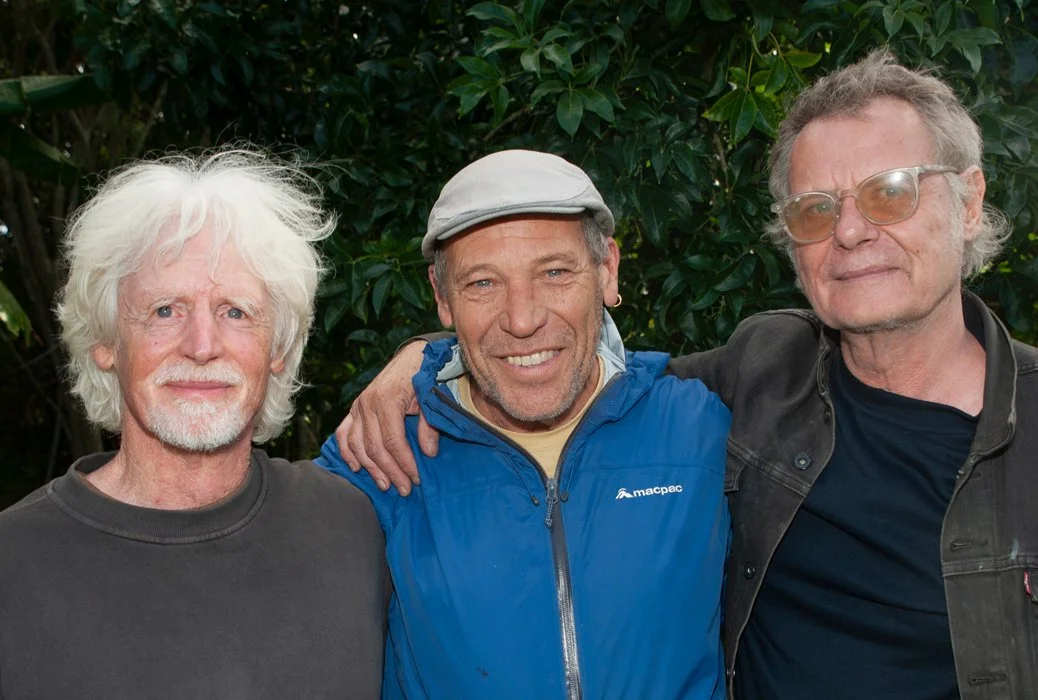
Representatives from The Growth Industry Group – Richard Mathieson, Steve Woodward, and Andrew de Boer.
Shortly after the Huakaiwaka Visitor Centre was opened in 2005, the Growth Industry Group of 16 sculptors got together to present a pop-up show at the Auckland Botanic Gardens. The success of this led to the introduction of a biannual exhibition that started in 2007 – the first Sculpture in the Gardens. To celebrate the tenth exhibition and 21 years of the Growth Industry Group, 12 of the original sculptors and three new members have come together to present a collection of medium scale works entitled The Welcoming Wave.
Sadly from the original 16, Greer Twiss and Barry Lett are no longer with us, and Chiara Corbelletto and Fatu Feu‘u are unable to participate this year. Steve Woodward, Bill Hayes and Charlotte Fisher join Andrew de Boer, Dr Richard Shortland Cooper, Leigh Christensen, Dr David Guerin, Samantha Lissette, Christine Massey, Richard Mathieson, David McCracken, Neil Miller, Marté Szirmay, Jeff Thomson, and Jim Wheeler.
About the Growth Industry Group sculptors and their works
-
Since his first solo exhibition in 1987, Andrew de Boer has developed a sculptural practice grounded in the transformative potential of making, influenced by his belief in the ‘transcendent potential of object making, locating in manual labour and material process the source of his sculpture’s energy’ (Barton, 1994).
Inspired by the Botanic Garden’s contribution to rewilding Aotearoa New Zealand, On Transparencies and Full Disclosures embodies the resilience and vitality of nature, and promotes sustainable forestry and a more balanced relationship with the environment.
-
Originally training as a graphic artist, Leigh Christiansen learnt to carve under the direction of Master Carver Alan Nopera. His work has been exhibited widely throughout Aotearoa New Zealand, including at sculpture shows such as NZ Sculpture Onshore.
Beaked Figures – Tight Five Scrum, carved from a rimu gate post, represents birdlike beaked-head on a generic Tekoteko-like body style. Carved to suggest a tight five rugby scrum formation, figures on top of the head follow a totemic convention representing ancestry and spirituality.
-
Inspired by pre-colonial Māori art and the vibrant culture of his homeland, the Cook Islands, Richard Cooper draws inspiration from the lush environment, people, cuisine, and traditions of both regions. Exhibiting both nationally and internationally, Richard has also created numerous large-scale public artworks that enrich community spaces, reflecting his commitment to cultural expression and community engagement through his artistic practice.
Tūmanako (Hope) embodies a positive outlook on the future, blending Māori culture with technological advancements. It symbolises optimism, growth, and the potential for innovation to enhance cultural connections and wellbeing, reflecting the inspiring vision of a harmonious future where tradition and technology coexist and thrive together.
-
Charlotte Fisher graduated with a Bachelor of Fine Arts in Sculpture from the Elam School of Fine Arts, University of Auckland in 1989 and has exhibited widely in both solo and group exhibitions. In 1993 she was the Rita Angus Artist in Residence. Charlotte’s sculpture is held in both public and private collections throughout Aotearoa New Zealand.
Charlotte creates organic, abstract forms using a combination of purchased, salvaged, donated demolition timber, recycled wood, and naturally found objects. Dark Matter forms part of an ongoing sculptural series that explores these ideas, drawing inspiration from the concept of dark matter, whose existence was demonstrated by astrophysicist Dr Vera C. Rubin in the 1970s.
-
David Guerin is a Hawke’s Bay-based contemporary sculptor. With memory as the central concern of practice, his work investigates how miniature sculpture can memorialise and commemorate collective events, while drawing on the power of individual stories and personal narratives.
As our anchor stone, memory is about time and about looking back to help us better map our future(s). With this aim, David’s work Searching for Carl Sagan’s “mote of dust in a sunbeam” might just be not only a bulwark against the oblivion of that future, but also a cheerful marker for the temporality of everyday life.
-
Originally from New York, he worked in foundries in the US before emigrating to Aotearoa New Zealand over 25 years ago. Skilled in bronze casting, ceramic sculpture, restoration and maintenance, his sculptures are held in private collections throughout Aotearoa New Zealand and internationally. Bill is a member of the Medallion Group of sculptors (MANZ).
The Council of Ravens explores the relationship between nature, architecture and watchfulness. A group of ravens occupies a circular, temple-like structure, appearing to gather in council and quiet conversation. Hand-built in ceramic, the sculpture is finished with layered green and earthy glazes that highlight its textured surfaces and the individual character of each bird. The solid kwila base contrasts with and grounds the detailed ceramic form, giving the work a sense of permanence.
-
Samantha Lissette works extensively in all scales of the bronze medium, from the miniature to the monument. She exhibits regularly work and her work is in public and private collections across Aotearoa New Zealand and internationally. Samantha is a member of Medal Artists of New Zealand (MANZ) and exhibits regularly with FIDEM International Medal Makers Congress.
Sanctuary is a meditation on the importance of finding an inner refrain, exempting the clutter of the world beyond our internal boundaries, the inner landscape we ourselves control. “Within you there is a stillness and a sanctuary to which you can retreat at any time and be yourself” Hermann Hesse. “Within, within. This is where the World’s treasure has always been.” Lao Tzu.
-
Christine Massey holds a BFA and a master’s in Museum Studies (MusSt). Material culture informs the basis for many of the concepts in her bronze installations and art medals. She is a founding member of Medal Art New Zealand (MANZ) and is the Aotearoa New Zealand delegate for FIDEM, the international group for art or object medals (hand held small sculptures).
DIBS acknowledges and honours the Auckland Botanic Gardens’ research programme to potentially save plants from extinction. It is inspired by the ‘dibber’, a traditional gardening tool used to make holes in the soil to plant seeds and seedlings. ‘Dibs’ means ‘authentic’ or ‘raw’, and is also slang for claiming space or territory.
-
Born in the Wairarapa and raised in Taranaki, Richard Mathieson studied sculpture at Elam. A long-standing MANZ member, he is actively involved with the group. Alongside his sculpture practice, he has a strong interest in curating and presenting sculpture exhibitions and has been very involved with the development of the Sculpture in the Gardens project. Richard lives and works in Māngere Bridge, South Auckland.
Scientia is a sand cast bronze depiction of a classical pointed cathedral arch housing a molecule made up of varied bonded atoms. It is a homage to the science of exploration and the endeavour to understand what we are, and the nurture and protection of what we have, values epitomised by Auckland Botanic Gardens.
-
David McCracken is a sculptor with a background in the performing arts. He specialises in medium to large fabricated works in ferrous and non ferrous metals.
Heavy metal pressure vessel is a spherical assemblage of mismatched curved rectangles asymmetrical ‘negative’ spaces. Intentionally ambiguous, it implies a device to contain explosive inner energy or crushing exterior pressure. It is intended as 3D parable of the self portrait.
-
Neil Miller exhibited painting and sculpture or over 20 years before concentrating on public sculptural works. He turned his focus to watercolour in 2016 and, more latterly, oil painting, investigating its meaning and relevance to 21st century Aotearoa New Zealand.
Trap is a 1990 work made of steel that is a sculpture about the inside of a sculpture, and a nod to the eradication of pests.
-
Marté Szirmay is a graduate of the University of Auckland, Elam School of Fine Arts and the Auckland College of Education. Her work is represented in private or public collections in New Zealand, and abroad. Throughout her career Marté has investigated a variety of materials and processes
Sun Returns is a homage to the sun. Nothing is more important to us than the sun’s heat and light, giving energy to all food chains and oxygen for life. Without it the Earth would be lifeless ball of ice coated rock.
-
Jeff Thomson has been a full-time sculptor since 1985, working predominantly with corrugated iron as a building material, exploring it in a myriad of ways. This is his eighth participation in Sculpture in the Gardens. He lives and works in a large warehouse in Helensville, Auckland.
What I am reading is a sculpture about books and reading, appropriately themed to the Gardens with the titles predominantly based on Aotearoa New Zealand gardening and sculpture publications.
-
Having studied forest ecology alongside sculpture at university Jim Wheeler’s choices are guided by both disciplines. The focus of his work is the growing, guiding behaviour of native plants within their environment and the regenerative power of nature with the goal of finding parallels between the human condition and nature while drawing attention to discovered beauty.
Around the time of Matariki, the tip of every stem begins to sprout new growth. Pohutukawa leaves start to bud forming velvety stalks that grow longer as new leaf heads form outwards two by two from the stem. Emergence – Pohutukawa Leaves (The Welcoming Wave) represents and marks the rejuvenating cycle of Spring.
-
Steve Woodward studied Fine Arts in Canada before learning to carve in marble in Italy, and moving to Aotearoa New Zealand in 1989. He has had exhibitions and commissions nationally and internationally. Steve has his studio at the Corbans Estate Arts Centre and lives in Titirangi.
A tumbled house with surface maps from the imagined to the historical, the idealised and the oasis.
A folded side – Green in the middle – a depiction of the Botanic Gardens as an oasis in suburbia.
An end – an imagined map from a thousand years ago
The other end – World without standing armies
The other folded side – Island bird